November 21, 2012
Today I joined an organized tour entitled "The Best of Tuscany". The tour passed through towns to the south and west of Firenze (the Italian name for Florence), with stops in Sienna, San Gimignano, and Pisa. We also stopped at an organic farm about 10 minutes from San Gimignano for lunch that featured food sourced almost entirely from the farm, the only "imported" food being the pecorino cheese, which is made from sheep's milk and the farm does not have sheep. Everything else was produced on the farm including the olive oil, the cold cuts, the vegetables and the wines. So, let me give you some impressions of the three towns, and, of course, the pictures.
Siena: Siena is an iconic Tuscan hill town that dates from the third century BC. It was a direct rival of Florence and Pisa when Ital consisted of a series of city states during medieval times, particularly the 13th and 14th centuries. What made Siena unique was it's location which is not near a river or the ocean as was the case for most cities. Instead it grew to cityhood and power because it lay on the most direct north-south route for pilgrims headed for Rome. In fact, until the 1970's this was still the case. Historically, however, Siena's foremost industry has been banking. This started as a service to the pilgrims and to the poor of the city. The world's oldest continuously functioning bank (Monte Dei Paschi de Siena) is located in Siena having been founded in 1472, and the office of the chairman is still in the same office in the same building as it was in 1472. Over 70% of the shares of the bank still belong to the city of Siena (it was originally set up as a bank for the poor of Siena), although the bank has expanded beyond Siena and has offices around the world.
 |
| Headquaters of the world's oldest continuously running bank-founded in 1472! |
 |
| The Chairman's office is the window on the left of the top row, where it has always been since 1472! |
The heart of the city is the Piazza del Campo, a sea-shell shaped "square" in front of the Town Hall that is the home, each July 2 and August 16, of the famous Palio horse race. The square was once a major source of water for the city-the square slopes down to the Town Hall and a drain, that still exists, collected the water, but now it is the focus of the town twice a year for the 1.5 minutes it takes to run the race. The race is partly a religious observance (it is held to honor the Virgin Mary) but it's mostly about civic pride as it pits the 17 communities of the town against each other. I won't go into the details of the race (you can get those online and watch some of the past races on YouTube) but just say that about 35,000 people spend all day jammed into the center of the square to watch the race and hundreds more spend hundreds of dollars to rent space in the surrounding buildings to watch the race. How serious do they take this race? One year, two leading communities had real good chances of winning the race so one bribed the jockey of the opposition to throw the race. He did but very convincingly so was dragged of his horse and severely beaten. When he regained consciousness in the hospital all he could do was smile because he had been paid about $750,000 to throw the race!!!
 |
| The Piazza del Campo, Siena, home of the famous Palio horserace. |
 |
| The Siena Town Hall and Tower. This tower and the Duomo (cathederal) tower are the same height to preclude any suggestion of competition for power (the cathedral is, however, on the highest point in the city so there may still be a point being made !!) |
 |
| Another view of the Town Hall from across the Piazza del Campo. |
 |
| San Domenico, another church in Siena |
 |
| The classic Tuscan hill town |
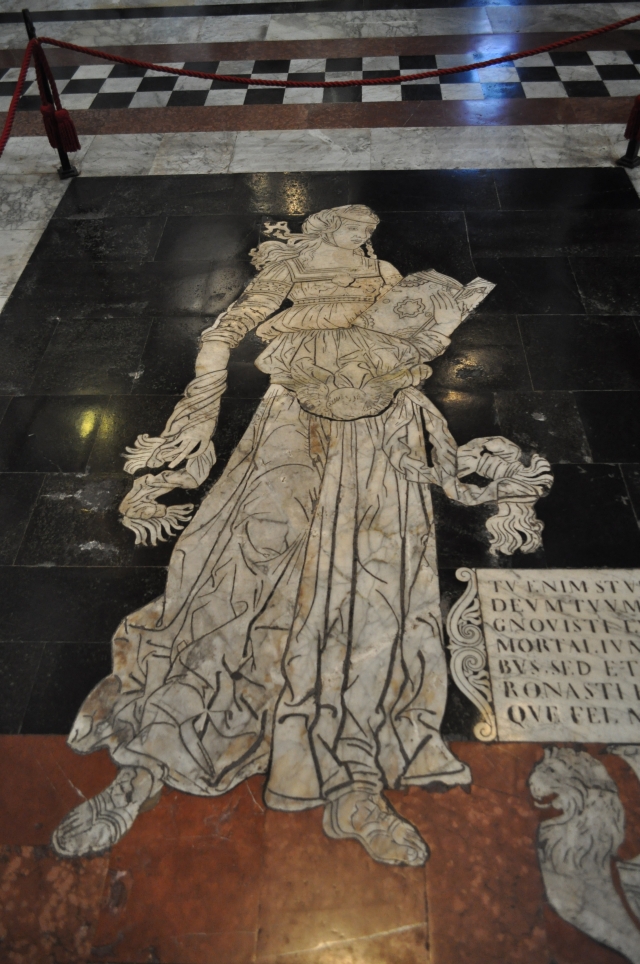
The other feature that Siena is famous for is the Duomo, or cathedral,
that sits on the highest point in town. It has some art works by some of
the famous Renaissance artists, an altar by the master altar makers of
the Renaisance, the father and son team of Nicola and Giovanni Pisano,
and even four sculptures by a young Michelangelo. But it's most famous
feature is the floor, an inlaid marble floor, in 56 panels, that took
200 years and 40 artist to complete. The marbles used are the most
expensive and rare marbles available and are true inlays into a marble
base. The lines defining the various images are carves and inlaid not
just painted and the result is amazing. The whole floor has not been
viewed for many years (significant parts are covered by carpet) but what
you can see is still incredible.
 |
| The facade of the Duomo. The ornate structure is due to the amount of money given by the rich families of Siena - they were threatened with hellfire for practicing usury (a sin in those days) so they tried to buy their way out with lavish donations to the Church. |
 |
| Part of the detail of the facade |
 |
| The interior is very ornate. The high altar is one of only four in existence by the Pisano father and son team |
 |
| The interior decoration of the dome |
 |
| The marble inlaid floor is a true inlay featuring the finest and most expensive marbles available from the then known world. It took 200 years and 40 artists to complete |
 |
| More of the floor |
 |
| The four statues located around the central niche were commissioned from a young Michelangelo and are the original sculptures not copies |
 |
| The belltower of the Duomo. The exterior decoration is very striking with the alternating colors. |
 |
| A narrow street leading down to the Piazza del Campo |
 |
| I discovered this interesting little courtyard by following a little alley of a street through Siena |
 |
| Details of the frescoed ceiling of the courtyard porch |
Lunch: After about an hour in Siena we then headed out to our lunch location. The meal itself was quite simple-a bruschetta appetizer, a pasta dish, a green salad with pecorino cheese and cold cuts (salami and proscutto), and a biscotti dessert. Each course was accompanied by a wine produced by the farm, starting with a Vernaccia wine that is unique to the San Gimignano area, a Chianti (this IS the Chianti region afterall) with the pasta, a second red with the cheese and cold cuts, and a dessert wine with the biscotti.
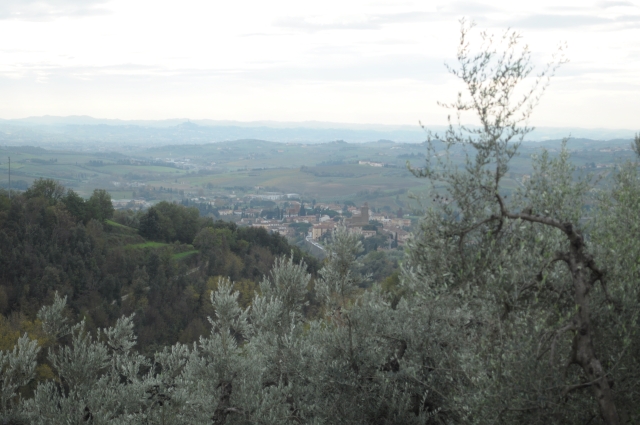
After lunch, we had about 20-25 minutes to admire the views from the farm. This included our next destination, San Gimignano, in the distance.
 |
| The entrance to the farm where we had lunch |
 |
| The view from the porch of the farm looking toward San Gimignano in the distance |
 |
| San Gimignano with its distinctive towers which earned it the nickname of the Medieval Manhattan |
 |
| The obligatory photo |
San Gimignano: Sna Gimignano is a small hill town that has made the decision to not allow any new building within the medieval town walls and is, thus, one of the best preserved hill towns in Tuscany. It has also been nicknamed "the Medieval Manhattan" because of the towers that dominate the skyline. In Medieval times the richest families in town built towers to demonstrate their wealth and prestige. In San Gimignano, the families turned tower-building into a competetive sport and eventually 72 towers, each higher than the last, were built. At this time, the town council stepped in and declared that no tower could be higher that the Town Hall tower, which led to many towers being cut down. One family took a different approach and built two towers, adjacent to each other and of legal height, with the idea that anyone seeing these two towers would realize that this was a rich and powerful family. These towers still stand. You can climb the Town Hall tower (which I did) and get some great views over the town and the surrounding country. I also climbed up to the La Rocca di Montestaffoli, the town's fortress, that also gives some outstanding views of the countryside around the town. Again, we had about an hour in town before rejoining the bus for the 1.5 hour drive to Pisa.
 |
| The entrance gate into San Gimignano |
 |
| Part of the city wall |
 |
| The road from the gate leading up to the main town square. This the main tourist shopping street |
 |
| Another view of the street. |
 |
| The view from the town fortress. |
 |
| Looking over the town and into the surrounding countryside. |
 |
| Some of the remaining towers in San Gimignano - there were as many as 72 in the hey day of tower building in medieval times, before the town council intervened in the battle to build the biggest tower. |
 |
| The Torre Grosse - the Town Hall tower - is the largest tower in town now, by law. |
 |
| Part of the view from the top of the Torre Grosse |
 |
| Another view from the Torre Grosse |
 |
| Looking down on the town fortress. |
 |
| The main town square. |
 |
| The two adjacent towers in this picture were built at the same time by the same family to make a point without violating the town council's dictate. |
Pisa: We arrived in Pisa right around sundown (which occurs between 4:30 and 4:45pm) but this only made the white marble of Pisa's iconic Leaning Tower more remarkable. While the tower is what Pisa is known for, what is not as well known is why the tower was built. The orignal intent was for it to be the free-standing belltower of the Pisa Duomo which, together with the Baptistry and Tower, form a complex of buildings on the Field of Miracles. The big mistake the builders made was to build a tower containing 15,000 tons of marble on wet silt. Fortunately for them, after building theree of the planned eight floors, political events (war) intervened and halted building for years. When building restarted the existing structure was already leaning so the fourth floor was built deliberately to "correct" the lean, which did nothing but give the tower a "banana" shape. Eventually all eight floors were built (and bells were even hung) but nothing could stop the slow increasing lean. Well, an estimated $30 million and 800 tons of lead in the basement seem to have halted the lean today and for the first time in the towers history, it is not moving, and should remain stable for the next 200 years. You can now climb the tower once more, which I did. An interesting observation was that the steps appeared to be installed on the assumption that the tower would be vertical and now follw the slope of the tower, that is, on the "down" side of the tower they slope to the outside of the tower and conversely on the "up" side of the tower. They are also heavily worn indicating that many people have climbed the tower in the last 800 years.
 |
| The iconic Leaning Tower of Pisa. |
 |
| The Pisa Duomo, or cathederal, for which the tower was intended to serve as a free-standing bell tower. |
 |
| The Duomo's Baptistry |
 |
| The tower is now stable at it's 1860's angle. At one point before being stabilize it was 4.5 meters from vertical!!! |
 |
| The view over the Duomo and the Baptistry from the top of the tower. |
 |
| Another view of the Duomo and Baptistry. |
 |
| The bells for which the tower was originally built are in place at the top of the tower. |
 |
| Looking towards the center of medieval Pisa from the top of the tower. |
 |
| What can I say? |
Other things that Pisa should be known for include:
1. It's the birthplace of Galileo, and he taught mathematics at Pisa University, as did Leonardo Fibonacci
2. Pisa is a University town. The official town population is around 80,000 - 90,000 with another 60,000 students
3. Pisa is an old city, maybe as old as the 9th century BC; the Romans referred to it as an old town
4. Pisa was a major naval power in the Mediterranean in Medieval times (the source of its wealth and power) and had trading links throughout Africa and the Middle East.
5. It was also a major shippbuilding site for Rome, based on 16 perfectly preserved Roman vessels unearthed recently during achaeological investigations of the Medieval Pisan arsenal and shipyard.
After about 45 minutes at the Field of Miracles, it was back to the bue the 90 minute trip back to Firenze.
So, another long day but one that I enjoyed.